
Start with the work you want to change
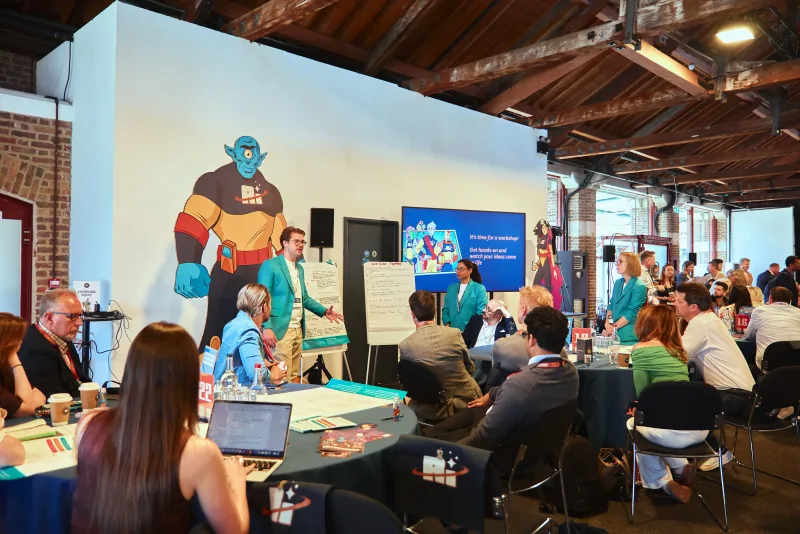
In Marcin Dobak’s Copilot workshop, teams examined whether their use case needed a workflow, an assistant or an agent. The choice shaped the controls they would need, so the discussion began with the work and the responsibility being delegated.
These questions give a team a useful starting point for that conversation:
| Approach | Questions to work through |
|---|---|
| Workflow | Which steps can be set out in advance, and where does a person need to review the result? |
| Assistant | Who is it helping, what information can it use and which decisions stay with that person? |
| Agent | Which decisions and actions are you delegating, and where must it stop or ask for approval? |
The boundaries took some working through: two groups could not fully resolve the agent-versus-assistant distinction during the session. The Copilot workshop output captures why that classification was useful even when the answer needed more discussion.
Agree the boundaries with the team
The groups used the Pharma AI Design canvas to examine users, data, red lines, governance and barriers to production. Their concepts included regulator-meeting war games, clinical-trial gap analysis and supplier onboarding. Each gave the participants a different set of questions about what information could enter the system and what it should be allowed to do with it.
Asking what a tool should not do helped make the scope more concrete. People could then discuss the permitted actions, the points where someone needed to make a decision, and the parts of the workflow that would need review. The canvas gave those conversations a structure that participants wanted to take into their own Copilot projects.
Build trust as the work becomes more sensitive
Kyriakos Tempriotis’s staged approach to an investigation workflow was a useful example from the main programme. He described starting with public court judgements, moving to historical internal declarations and then working towards live investigations. That progression let trust develop alongside the increasing sensitivity of the task.
The compliance case study explains the example, while the full report connects it to the choices about ownership and access discussed across the day. Those choices affect who will use an AI tool and what they will trust it with.
What participants explored in the workshops
In the session led by Ana Roibu and Caz Canavan, participants explored a congress insight dashboard, an SOP alignment tool and an insights-to-PowerPoint workflow. They also worked through ideas for a Copilot agent, a day-planner app and an ABPI triage tool. Guided coding gave them a way to describe a problem and begin testing a possible build.
The tools available inside an organisation shaped what people could try. Participants adapted prompts and steps for Copilot, and explored pared-down workflows where their environment limited the build. The agentic-AI workshop summary records that practical problem-solving alongside the target applications.
The vibe-coding workshop added another useful perspective: people with little or no coding experience could judge an output as users. Trying a build and explaining what needed to change helped them make the next version more useful.
Take a short brief into the next conversation
The workshop discussions give teams a practical set of questions to answer together before committing to a build:
- Who uses the workflow, and which part of their work needs to change?
- What data can the tool use, and who controls access to it?
- Which actions can it take, and what must remain outside its scope?
- Where does someone need to review, approve or stop the work?
- How will the people using it judge whether the result is useful?
The AI tools workshop approached those choices at the level of individual tasks, using the ATLAS decision guide to examine high-burden work and data handling. Together with the Copilot canvas discussions, it gives a team somewhere concrete to start.